

Real-time digital production control
MES System, - Transparency, control and efficiency in production.
A MES System (Manufacturing Execution System) serves as the central interface between production planning and the shop floor. It ensures that manufacturing processes are monitored, controlled and documented in real time. Production data, machine statuses and operational information are collated and analysed by MES software, and made available to support informed decision-making.
A MES system creates transparency in production, reduces downtime, and supports companies in sustainably improving their manufacturing performance.
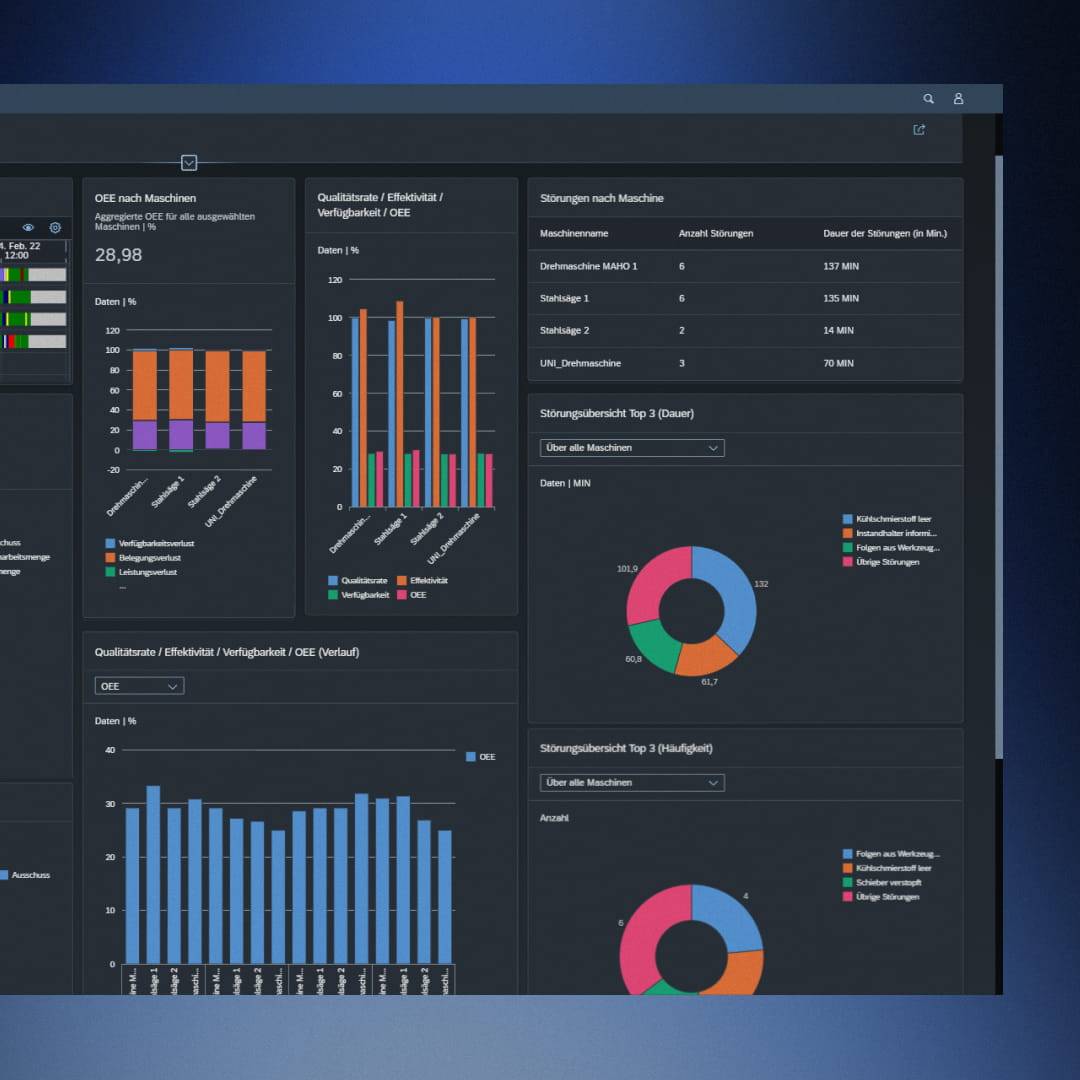
Manufacturing Execution System (MES) Overview
What is an MES system?
An MES (Manufacturing Execution System) is a software solution for controlling, monitoring, and documenting ongoing production processes in real-time. It connects the world of machines and workers on the operational shop floor level with higher-level production planning. The primary goal is to create transparency over current orders, resources,.
It thus provides the basis for quick and fact-based decisions. It is the digital backbone of modern production and a key factor in improving efficiency and quality.
MES System Definition
A Manufacturing Execution System (MES) is a software solution for controlling, monitoring, and documenting production processes in real-time. It captures production data such as order status, machine states, quantities, times, or quality information and provides it centrally for analysis, evaluation, and optimisation.
Greater transparency, efficiency and control in manufacturing
Why are MES systems important in manufacturing?
The demands on modern production facilities are constantly increasing: more variants, shorter delivery times, and higher cost pressure, all while quality expectations rise.
MES systems create the necessary transparency and controllability here., by providing real-time visibility into production processes and offering targeted support:
Transparency: Current status of orders, machines and resources available at any time
Fast Responsiveness Standstills, deviations and disturbances are detected immediately
Quality assurance Continuous recording of process and quality data
Cost control Reduction of scrap, rework, and unplanned downtime
Stable processes Comparable, measurable, and reproducible production processes
In short: A MES System, production power measurable, controllable and continuously improvable.
MES Software How it Works
How does an MES system work?
A MES system continuously captures production data in real time, which is automatically provided by machines, systems, and sensors, as well as through manual feedback from workers.
This data (e.g. quantities, downtime, material consumption) is then linked to orders, materials and resources within MES software, processed in real time and compared against target figures, thereby providing a comprehensive understanding of what is currently happening on the production floor.
Based on this real-time data, MES production software supports operational production control: orders are monitored, deviations are detected early, and processes are specifically adjusted. At the same time, the system ensures complete documentation throughout the entire manufacturing process.
Results, key figures, and status messages are immediately available for analyses, reports, and optimisations. This creates a closed control loop of data acquisition, evaluation, and control with a MES system.
In a nutshell:
Capture data (machinery & employees)
Merge data (MES system)
Evaluate, Key Figures & Generate Alarms
Feedback and control of processes
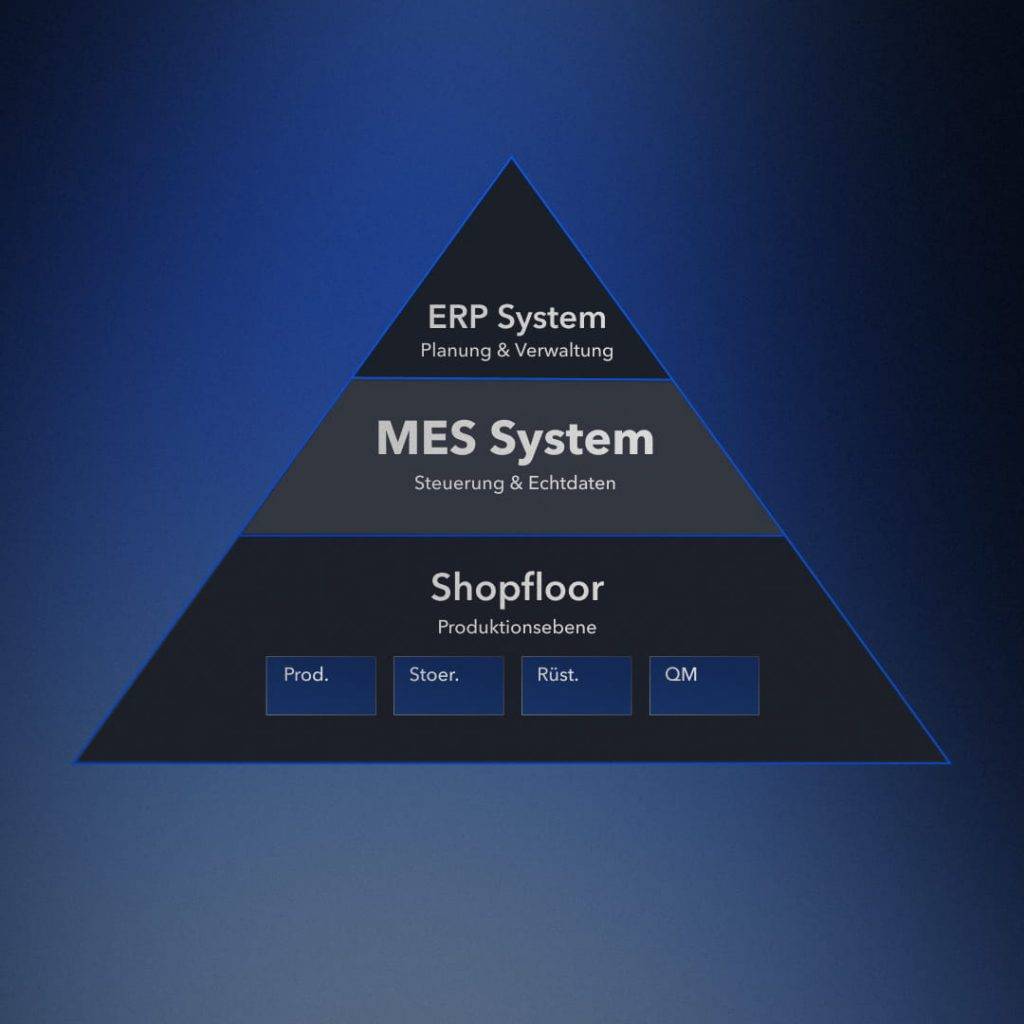
MES Software
Ein Manufacturing Execution System (MES) hat folgende Funktionen: * **Produktionsplanung und -steuerung:** Überwachung und Steuerung des gesamten Produktionsprozesses in Echtzeit. * **Datenerfassung und -analyse:** Sammeln von Produktionsdaten wie Maschinenlaufzeiten, Stückzahlen, Materialverbrauch und Qualitätsinformationen, um Engpässe zu identifizieren und die Effizienz zu steigern. * **Qualitätsmanagement:** Überwachung von Qualitätsmerkmalen, Erfassung von Ausschussdaten und Durchführung von Qualitätsprüfungen. * **Rückverfolgbarkeit:** Nachverfolgung von Materialien und Produkten entlang der gesamten Lieferkette. * **Leistungsverfolgung (OEE):** Messung der Gesamtanlageneffektivität zur Optimierung der Produktionsleistung. * **Ressourcenmanagement:** Verwaltung von Personal, Maschinen und Material im Produktionsprozess. * **Integration mit anderen Systemen:** Anbindung an ERP-Systeme (Enterprise Resource Planning) und SCADA-Systeme (Supervisory Control and Data Acquisition).
A MES System, (Manufacturing Execution System) forms the central control and information layer between ERP systems and the shop floor. It ensures that production processes become transparent, controllable, and evaluable. Modern MES Software consolidates all relevant production data in real-time and provides it in a context-dependent manner.
Production monitoring
One of the core functions of an MES system is the continuous monitoring and control of ongoing production. Production orders, machine statuses, and process progress are recorded and visualised in real-time.
Read more
The MES Production Software allows for the immediate detection of deviations, targeted intervention, and flexible adaptation of production processes. This helps to reduce downtimes and optimise throughput times.
Production Data Acquisition
In addition to MES, shop floor data collection (SFDC) captures all order- and personnel-related production data. This includes, for example, start and end times of operations, quantity feedback, or order status.
Read more
A MES System, This links this information with the machine data, creating a complete view of the production process – from order to completion notification.
Machine Data Acquisition
Machine Data Acquisition (MDA) is a central component of modern MES production software. Machines automatically supply information on run times, downtimes, malfunctions, or scrap quantities.
Read more
These data are processed by the MES Software processed directly and form the basis for transparency at machine and line level. This creates an objective picture of actual production performance – independent of manual feedback.
Quality Management
Another key area of application for an MES system is quality management. Test characteristics, measured values, and quality deviations are recorded and documented directly in the production context.
Read more
By directly linking with machine and process data, quality problems can be identified early on and analysed in a targeted manner. Furthermore, an MES enables complete traceability of batches, materials, and production steps. This ensures.
Traceability and documentation
A MES system ensures the complete traceability of materials, batches, and process steps. All relevant production and quality data are documented in a traceable manner.
Read more
The MES Production Software This provides a well-founded basis for decision-making for production management and leadership, and supports continuous process optimisation.
Analysis, key figures and reporting
Based on the machine and operational data collected, MES Production Software offers comprehensive analysis and reporting functions. Key performance indicators such as OEE, availability and scrap rates can be calculated and displayed automatically.


MES Systems in Practice: From Concept to Productive Implementation
The greatest leverage of an MES system lies not solely in its functional depth, but in its seamless integration into the existing production IT landscape.
In practice, however, it quickly becomes apparent that the actual benefit of an MES system does not depend solely on its functions, but above all on, how consistently and seamlessly the system is integrated into the existing production IT.
Many companies face the challenge of implementing a powerful MES system without creating additional complexity, process breaks, or redundant data structures. This is precisely where classic MES software solutions differ from modern, integrated MES systems, which have been specially developed for productive use in manufacturing.
MES System Benefits in Practice - Example
The MES system from IGH Infotec AG: Benefits of MES software for production
With the MES system from the IGH Infotec AG Companies receive a high-performance solution for the digital control and monitoring of their production processes. The system combines transparency on the shop floor with clear structures for planning, analysis, and optimisation – practical, scalable, and designed for industrial requirements.
Transparent KPI analysis in the MES system
A modern MES Software enables the central analysis of all relevant production key figures in real-time. Clear dashboards can be used to visualise KPIs, analyse details via drill-down, and configure individual views.
KPI
of the data in a
Bundled system
An MES system consolidates all production-relevant data in a central system. Machine, operational, quality, and process data are available consistently and in real-time. This creates a continuous database without media breaks. For maximum transparency along the entire value chain.
Identifying production pain points early with MES software
With MES software, critical conditions and deviations in production can be identified early. Disruptions, downtimes, or quality problems become immediately visible before they lead to major consequences. This allows for short reaction times, proactive action, and sustainable optimisation of production processes.
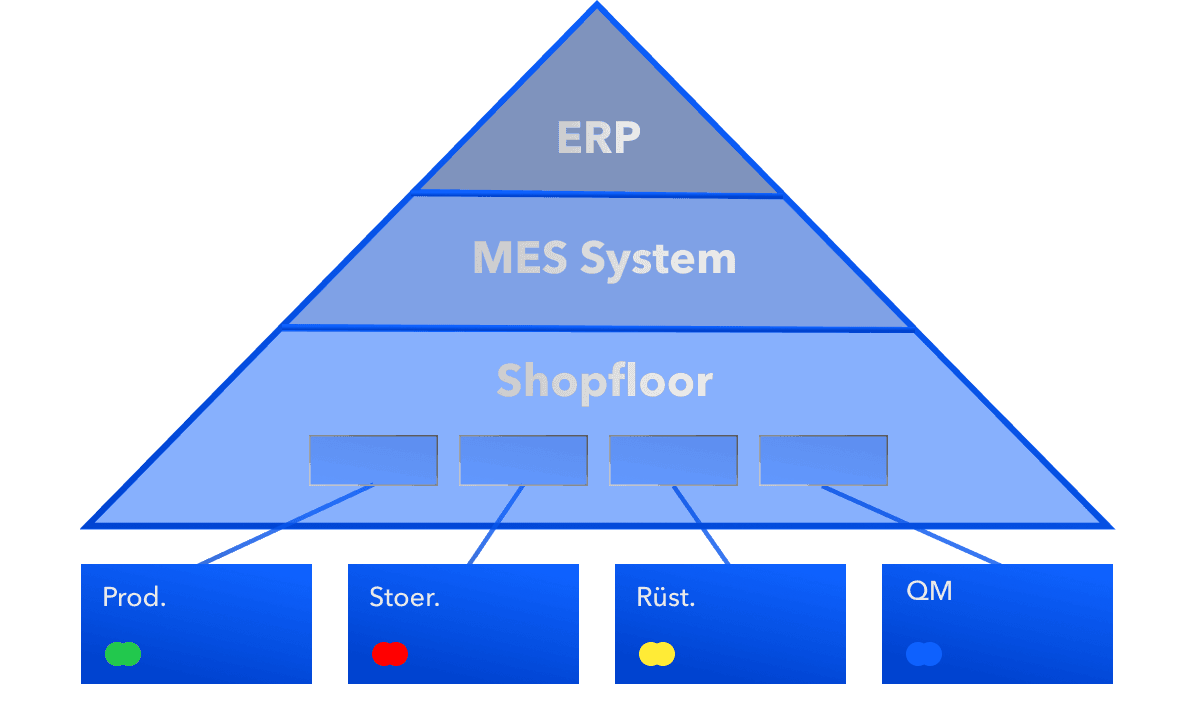
High scalability due to modular MES construction
MES production software should be modular and grow with the demands of production. Functions can be expanded step by step – from production monitoring, via MDE (Machine Data Acquisition) and BDE (Business Data Acquisition), right through to quality and analysis modules. This flexibility ensures that the MES system is suitable for both individual production areas and complex production environments.

MES system without interfaces
A modern MES Software ideally seamlessly integrated into the ERP system become. Instead of complex interfaces, companies benefit from a continuous flow of data between planning, production, and evaluation. For example, a SAP integrated MES, enables a consistent data basis in a single system and significantly reduces integration and maintenance effort.

Why the MES system from IGH Infotec AG?
Seamlessly integrated rather than connected:
IGH Infotec AG's MES system can be deeply integrated into existing SAP ERP structures, enabling a seamless data flow without complex interfaces.
Developed with practical production in mind:
Functions and processes are consistently geared towards real-world requirements in manufacturing and on the shop floor – not towards theoretical models.
Measurable real-time transparency:
Key production figures, statuses, and deviations are immediately available and form the basis for well-founded decisions and continuous optimisation.
Learn how an MES system makes production processes measurably more efficient.
In our events, we demonstrate how companies can create transparency, optimise processes, and sustainably increase production with an MES system, using real-world use cases (live demos, practical examples, and Q&A).
MES System FAQ
Frequently Asked Questions
Here you will find frequently asked questions about MES systems. Learn how
What is a Manufacturing Execution System (MES System)?
A Manufacturing Execution System (MES) is an IT system that monitors, controls and documents production processes in real time. It links the operational level of manufacturing with higher-level planning systems and ensures that orders, machines, materials and employee data are brought together in a transparent manner. MES systems thus lay the foundation for efficient, data-driven production.
What are the functions of MES software in production?
MES software records and processes production data directly on the shop floor. This includes, among other things, order monitoring, recording of machine and operational data, quality control, and product and material traceability. The aim is to make production processes more transparent, to detect deviations early on, and to continuously optimise processes.
Der Haupt
ERP systems plan and manage business processes at a corporate level, while an MES system takes over operational implementation on the shop floor. MES production software works much closer to machines and employees and delivers real-time data from manufacturing. Both systems complement each other: the ERP plans, the MES implements and reports current production data back.
For which companies and sectors are MES systems suitable?
MES systems are particularly suitable for manufacturing companies with complex production processes, high quality requirements, or a need for real-time transparency. Typical areas of application include mechanical and plant engineering, automotive, metal processing, the plastics industry, as well as series and variant production. Wherever production processes are to be digitally controlled and optimised, a Manufacturing Execution System offers clear added value.