

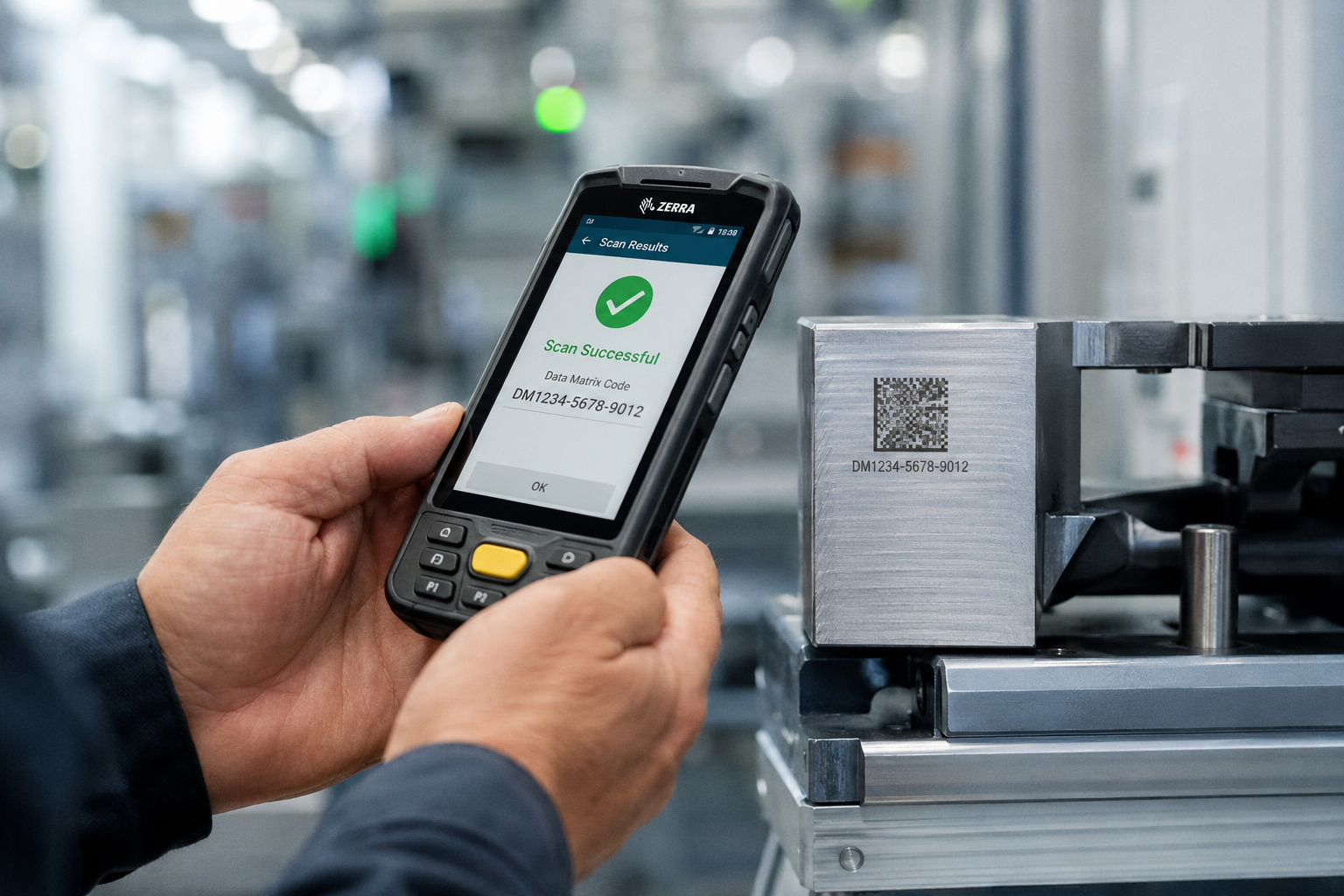
Why are 2D barcodes becoming increasingly important in logistics and production?
2D barcodes have evolved in recent years from a niche technology into a key component of modern logistics and production processes. While simple linear barcodes were once sufficient to represent information, the demands for data density, traceability, and robustness are continuously increasing. 2D barcodes make it possible to store significantly more information in a very small space and to read it reliably even under challenging conditions.
Limitations of Classic 1D Barcodes
1D barcodes (e.g., EAN or Code 128) store information linearly. This comes with several structural limitations: the amount of data is limited, print quality must be high, and reliable scanning is hardly possible once the code is damaged. In addition, traditional barcodes usually carry only an ID, while additional information such as batch numbers or serial numbers cannot be encoded. As a result, they quickly reach their limits in automated processes.
Requirements of Modern Logistics and Production Processes
Digital supply chains today require the unique identification of components and pallets, serial numbers, batch information and timestamps, as well as high reliability during scanning — all seamlessly integrated into ERP, MES, and WMS systems. These requirements can be efficiently met with 2D barcodes and modern matrix encoding.
What are 2D barcodes?
2D barcodes are two-dimensional codes that store information both horizontally and vertically. Unlike 1D codes, they use an area-based structure consisting of dots, squares, or modules. This significantly increases data density. Typical encoded content includes item and serial numbers, production data, URLs or reference numbers, as well as checksums and control characters.
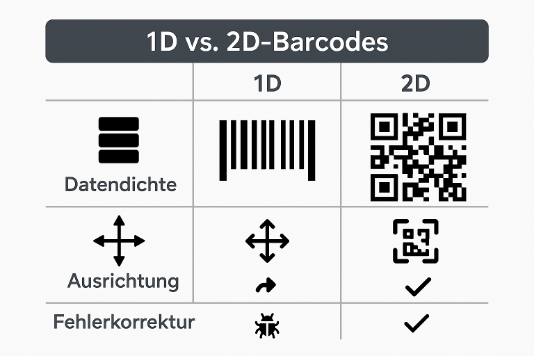
Difference Between 1D and 2D Barcodes
2D barcodes differ fundamentally from traditional linear barcodes:
- More information in a smaller space
- Omnidirectional readability (not just horizontal)
- Integrated error correction
- Improved readability in case of damage or soiling
How does matrix encoding work?
What is matrix encoding?
Matrix encoding describes the technical principle by which data is stored in a two-dimensional matrix of light and dark modules. Each module represents individual bits or groups of bits. Positioning elements ensure that scanners can correctly align and interpret the code. Matrix encoding enables high data density, supports different data formats, and allows redundant data storage for error correction.
Data Matrix, QR Code & Co.
The most well-known forms of matrix encoding include:
- Data Matrix Code (DMC): Especially common in industry and production
- QR Code: Frequently found in retail, marketing, and mobile applications
- Aztec Code: Compact, often in ticketing
- PDF417: Strictly speaking, a stack code, often used in government environments
In logistics and industry, 2D barcodes based on Data Matrix technology have become the established standard.
Data Matrix Code ECC200: The Data Matrix standard commonly used today is called ECC200. It uses Reed-Solomon error correction and remains readable even if up to 30% of the code is damaged. ECC200 forms the foundation for industrial applications and is a prerequisite for GS1-compliant marking.
GS1 Data Matrix: In the logistics and pharmaceutical sectors, the GS1 Data Matrix code is the standard. It combines ECC200 technology with standardized GS1 Application Identifiers (AIs) to enable unique, internationally readable product identification at the individual item level. The technical foundation is defined in the standard. ISO/IEC 16022:2006 defined.
Comparison of Common 2D Code Types
| 2D Barcode | Typical Data Volume | Correction | Advantages | Typical Areas of Application |
|---|---|---|---|---|
| QR Code | Very high (text, URLs, data) | High | Widely used, quickly scannable, smartphone-capable | Marketing, logistics, tracking |
| Data Matrix (DMC) | High on a very small area | Very high (ECC200) | Extremely compact, industrial-grade, DPM-capable | Production, automotive, medical technology |
| PDF417 | Very high (multi-line) | Middle | Large datasets, structured | Identification, documents, transport |
| Aztec Code | High | High | No quiet zone required, robust | Tickets, transport, governmental systems |
Note: Data Matrix and QR codes are the most commonly used 2D barcode types in logistics and SAP-driven processes.
How do 2D barcodes technically work?
Data Structure and Error Correction
2D barcodes combine payload data with verification information. Error correction algorithms (e.g., Reed-Solomon) enable data to be reconstructed even when parts of the code are damaged or contaminated. Matrix encoding allows defective areas to be partially ignored, ensures reliable decoding even with poor print quality, and supports stable operation in harsh environments.
Readability, Robustness and Direct Part Marking (DPM)
A key advantage of 2D barcodes is their high robustness. They can be scanned from different angles, captured with stationary or mobile scanners, and are omnidirectionally readable, meaning precise alignment is not required.
Especially in the metalworking and mechanical engineering industries, the so-called Direct Part Marking (DPM) plays a critical role. Instead of being printed on a label, the Data Matrix Code is applied directly to the component’s metal surface using methods such as laser marking, dot peen marking, or etching. As a result, the code remains permanently attached to the part, even if labels fall off or become unreadable. This makes DPM the standard wherever components must remain traceable for years, including the automotive, aerospace, and medical technology industries.
Which scanners read 2D barcodes and Data Matrix codes?
Not every scanner is suitable for 2D barcodes. Traditional laser scanners can only read 1D barcodes. Data Matrix codes and other 2D symbologies require imager-based devices. Instead of using a laser beam, these scanners use a camera and can analyze the complete 2D pattern of the code.
Stationary Imagers
Stationary scanners are permanently mounted on conveyor belts, goods receiving stations, or assembly lines. They automatically capture 2D barcodes as items pass through, without requiring a manual scanning process. They are typically used in fully automated logistics and production processes.
Mobile Handheld Scanner
Mobile handheld scanners with 2D imagers are the standard for flexible warehouse processes, inventory management, and goods receiving. They read all common 1D and 2D symbologies, including Data Matrix, QR Code, and PDF417. Robust industrial versions are designed for continuous operation in factory halls.
Industrial Smartphones and MDC Devices
Mobile data collection devices (MDCs) and industrial smartphones combine scanning functionality with software connectivity in a single device. They read 2D barcodes and transfer the data directly to SAP, MES, or WMS systems — eliminating the need for manual intermediate steps. For processes in manufacturing, warehousing, and on the shop floor, they are now the most widely used class of scanners.
Camera-Based Vision Systems
For direct marking (DPM) on metal, standard imagers are often not sufficient. Camera-based vision systems with specialized lighting (polarization filters, ring lights) can also reliably read low-contrast, etched, or pin-punched Data Matrix codes on reflective surfaces. They are used primarily in automated quality inspection and automotive manufacturing.
Where are 2D barcodes used in logistics and production?
Logistics and Warehousing
In logistics, 2D barcodes ensure the unique identification of load units, fast goods receipt and dispatch postings, and transparent inventory levels. The matrix encoding makes it possible to store all relevant information directly in the code without additional database queries, speeding up every scanning process and reducing dependence on network connections in the warehouse.
Production and Traceability
In production, 2D barcodes are key to seamless traceability. Serial numbers at the individual part level, the documentation of production steps, and the direct linkage to machine and process data can all be mapped using Data Matrix codes. Especially in the automotive and electronics industries, matrix encoding is now the standard, often in combination with direct part marking on components.
Quality Assurance
2D barcodes also play a central role in quality assurance. Inspection results can be assigned directly to a component, inspection plans can be accessed immediately via the code, and in the event of complaints, the complete traceability of every production step is ensured.
Advantages of Mobile Data Collection
When used with mobile devices, 2D barcodes unlock their full potential. Thanks to omnidirectional readability, precise alignment during scanning is not required, which noticeably speeds up every work step. Manual data entry is drastically reduced, and error rates decrease. Matrix encoding is particularly well suited for mobile scanners and industrial smartphones.
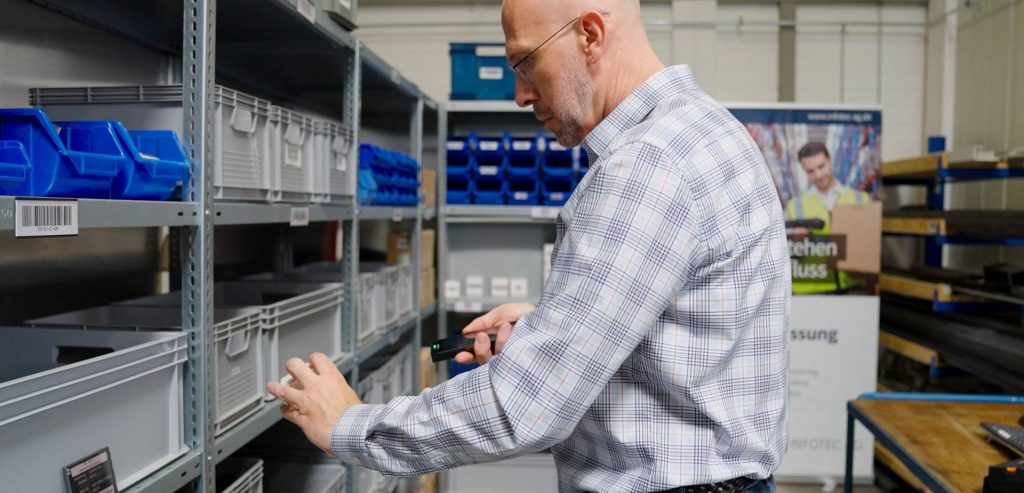
Practical Example: Matrix Codes with Solutions from IGH Infotec AG
In IGH Infotec AG customer projects, 2D barcodes are regularly used to identify components, containers, and production orders. Thanks to standardized matrix encoding, data can be captured via the mobile data collection solution and seamlessly integrated into SAP processes.
Typical advantages:
- Real-time transparency of material flows
- Simplified traceability
- Measurable efficiency improvements
Conclusion: 2D barcodes as the Key to Transparent Processes
2D barcodes have established themselves as an indispensable tool in logistics and production. Thanks to modern matrix encoding, they offer high data density, robustness, and flexibility. Companies benefit from improved traceability, more efficient processes, and reliable mobile data capture. As a result, 2D barcodes are a key building block for transparent, digital value chains.
