

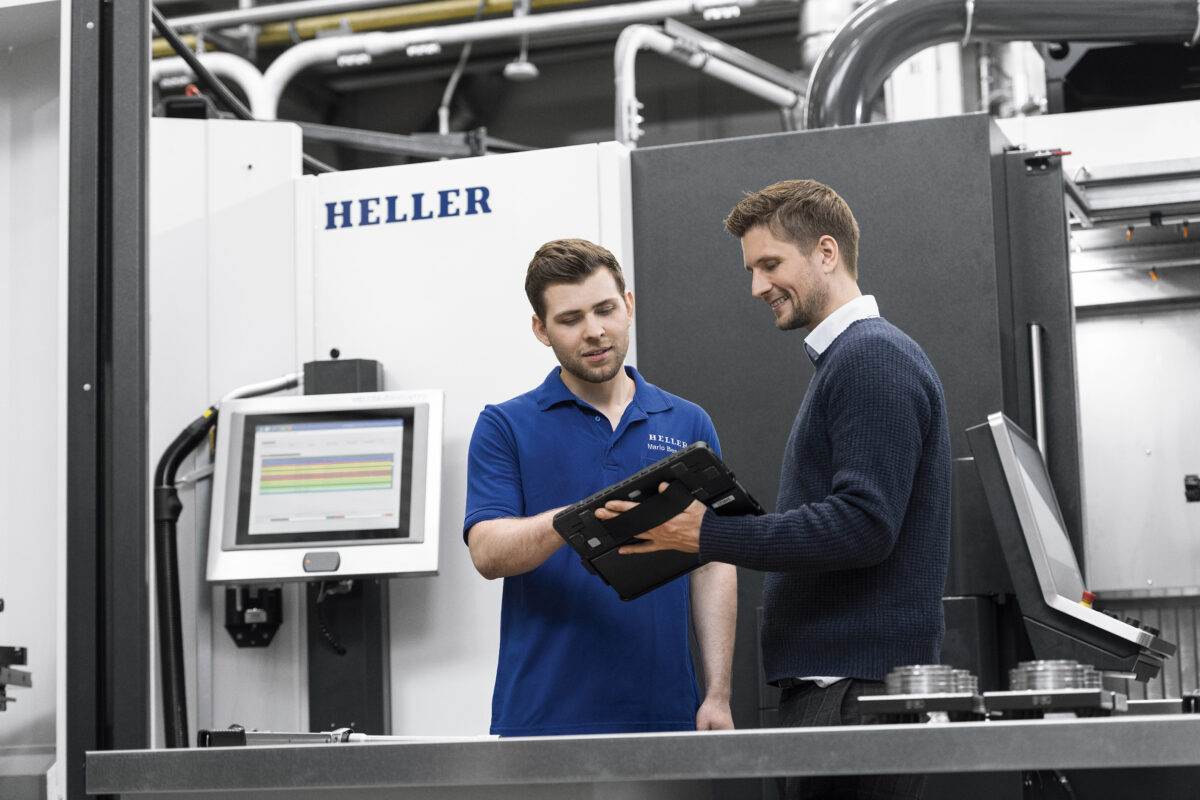
Six years ago, the management of Gebr. Heller Maschinenfabrik focussed on the competitiveness and future viability of production. The manufacturer of machine tools for 4- and 5-axis machining had been producing in Nürtingen and Brazil for a long time in the same processes, just above the limit of profitability. The liberating blow came with the integration of a Manufacturing Execution System.
Heller Maschinenfabrik mainly manufactures individual parts for its own machine assembly in Nürtingen and Brazil. In addition to the outdated production processes, until a few years ago there were often problems with adherence to delivery dates, and dependent trades such as assembly and service often had to intervene. The topic of 'digitalisation' was still in its infancy. Although feedback from the production process was recorded as actual time, this was based on the worker's entry on the work slip. There was also no separation between machine and personnel performance. The target specifications served more as a guideline or suggestion. Although efficiency measurements and the like were already being carried out selectively, a sustainable improvement process usually fizzled out quickly due to the lack of transparency.
Those Responsible Recognise the Need for Action
HELLER's management team was well aware of all this. As a result, the decision was made to make production more sustainable. The alternative would have been to close down production and source the parts externally. A separate project was launched to modernise the production processes. It quickly became clear which main areas needed to be addressed: It started with a closer look at the machinery. This involved categorising the machinery and sorting out irrelevant and obsolete machines. The database was then analysed. An initial topic included validating the existing target data against the actual data and detailing the data to be recorded. This also included the definition of
key performance indicators such as KPI parameters and their visualisation for the employee levels. In a further step, the team dealt with the selection and introduction of detailed order planning - based on valid production data to ensure adherence to deadlines. Finally, tools and equipment were also to be recorded in the system and the capital tied up there reduced.
Taking a Close Look at Production Processes
After a planning phase, the project group tackled the digitalisation of the production processes. The sub-project began with the definition of key performance indicators (KPIs). The participants were aware that the master data of the work plans was partly inconsistent. As a result, an MES was to be integrated first and then the detailed planning. This was to prevent the detailed planning from being filled with poor planning data. Very early on in the project, machine and personnel performance were separated from each other in the work schedules. This categorisation is essential for the correct evaluation of multiple machine operations, set-up processes parallel to production time or unmanned shifts in which the machine runs autonomously until the material is ready.
is processed or a malfunction occurs. This was followed by the definition of the production indicators. An important point is the feedback rate, i.e. the times reported back by the worker. The deviation between working time and confirmation time is the value to be analysed. The auxiliary wage or non-productive time, in turn, is an indicator that influences productivity. The additional consumption parameter indicates whether the target times have been exceeded due to faults. It is relevant here that the worker provides a reason for the excess consumption. Among other things, the non-productive time (NPT) can be calculated from these key figures. For machines, the running time and downtime are considered in relation to the processing order. In the event of a standstill, the cause, such as a malfunction or missing material, comes to the fore. Running times with reduced performance - keyword override - are also of interest. The number of pieces, rejects and rework must be recorded. These and other indicators were used to determine the data points. The data points can be found in the production process (worker), in the machine and in the ERP system.
Feedback Rate of 98 Percent
When introducing the Manufacturing Execution System, the focus was precisely on these data points. There was no need for a complex interface to the ERP system, as the decision was made in favour of a system environment integrated into SAP software. This meant that the data points were already available within the ERP. When configuring the shop floor dialogues, the project group made sure that the necessary information on the current order was available to the workers and that they could easily enter the data on the process. The ERP integration ensures up-to-date order and material data. The data exchange between
The machines could be implemented quickly. Numerous machines already had an integrated OPC server in the control system. The Brown and relevant Blackfield machines were equipped with an I/O converter in order to be able to exchange data. As a result, only a handful of machine data is required for the monetary evaluations of the processes. The MES went into operation quite smoothly - and after initial scepticism, the employees completed their feedback at the terminals with increasing routine. The feedback rate rose sharply and eventually levelled off at around 98 percent.
Prompt Evaluation for Optimisations
The effect quickly became apparent: discrepancies such as time overruns, incorrect allocations and so on were immediately recognised. Foremen and workers can discuss these immediately. Open questions can be clarified promptly and processes can be adapted accordingly if necessary. Before the changeover, minor problems in particular could hardly be addressed promptly. There was a lack of promptly visible recording of the feedback data and a usable evaluation.
Dashboards for Employees
The analyses of the collected data were based on the defined indicators. This was followed by the creation of personalised dashboards for the functional levels such as workers, foremen, quality assurance, work preparation and so on. Based on these dashboards, the project team developed instructions on how to proceed in the event of a deviation. If a deviation between target and actual values is deemed relevant, there is a prescribed course of action with clearly assigned responsibilities. The aim is to eliminate problems consistently, comprehensibly and effectively in order to ensure greater efficiency in production operations. A daily shop floor meeting is now held on this basis. Rules, a fixed time frame and recurring topic groups are intended to ensure the success of this tool.
Transparency Translated into Performance
After three years of the project, those responsible drew a positive conclusion. The feedback rate is now around 99 percent. The auxiliary wage or non-productive time has been reduced by 45 percent. In addition, deviations from the actual specifications, i.e. overtime, have been reduced. Processes for rework, quality assurance and idle times are now traceable. Machine availability has also increased. Ultimately, HELLER recorded a performance gain of 33,500 hours with around 200 operational employees: 15 percent growth in two years. Significantly better processes are essential for improved competitiveness - which was achieved on the basis of MES key figure transparency.