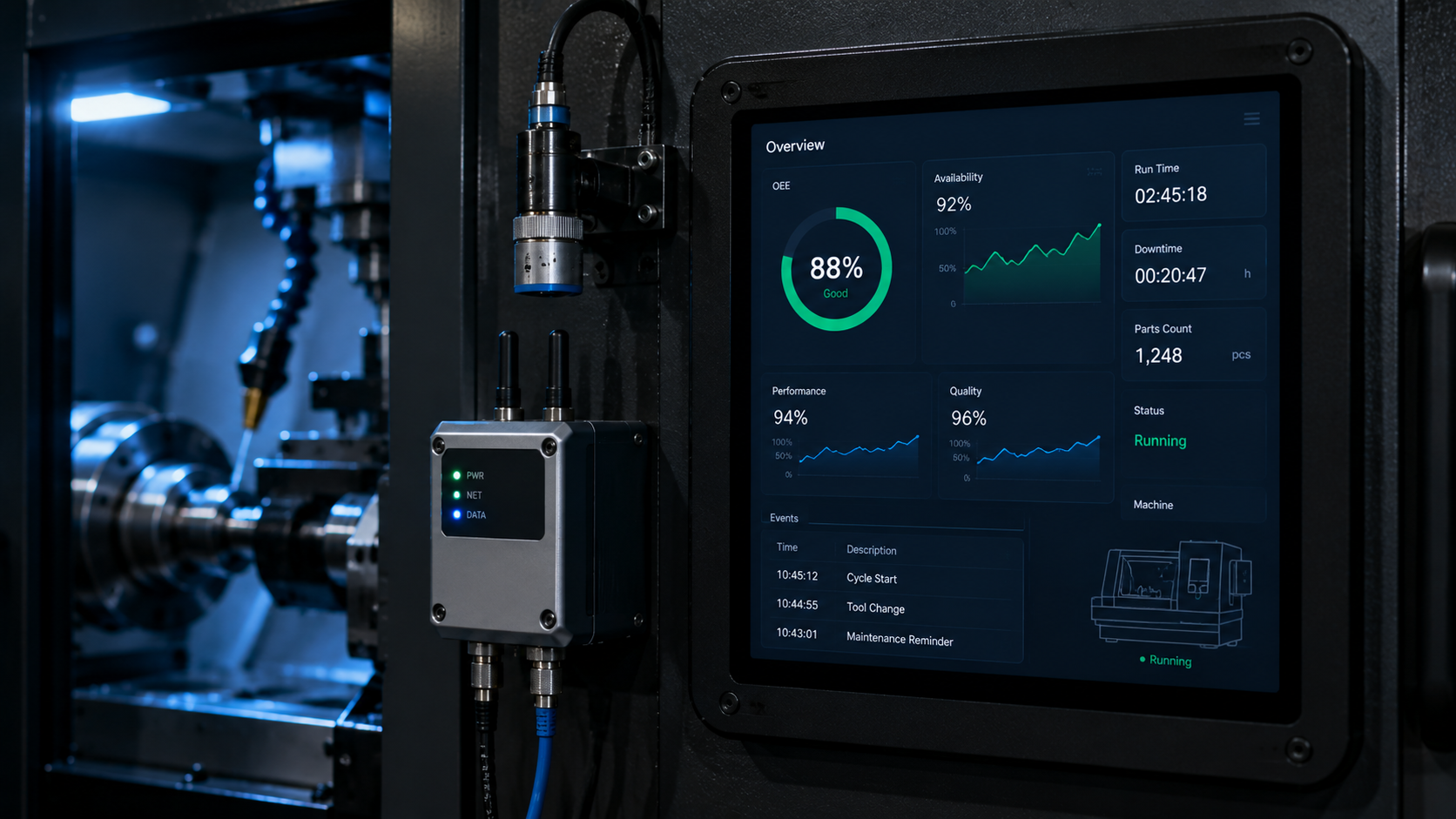
What does machine data acquisition have to do with an MES?
MDA stands for machine data acquisition: machine and process data are automatically captured from the equipment. The aim is to provide an objective view of machine status, performance and faults in real time.
An MES system records this machine data and links it with orders, work plans and quality data from the production data acquisition system. This turns raw machine signals into evaluable production metrics — contextualised, historised and visualised in a central dashboard.
MDA thus forms the machine data layer within the MES. What the machine is doing, whether it is running, stopped, experiencing a fault, or being set up, is transformed by MDA into a real-time, analyzable data point updated to the second. Without MDA, the MES knows only the order status based on PDA feedback, but not the actual, objective machine status behind it.
VDI guideline 5600 classifies machine data acquisition as a core function of an MES and defines it as the basis for production-relevant key performance indicators.
What machine data is there in manufacturing?
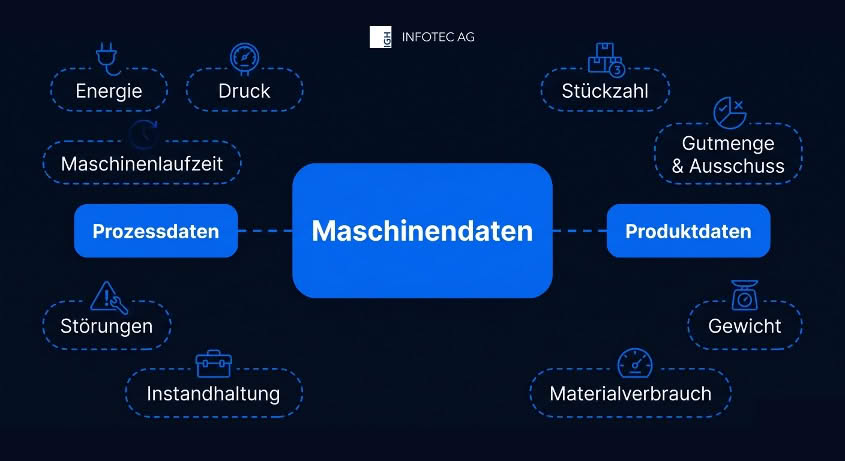
The data provided by an MDA system depends on the machine, the degree of automation, and the available interfaces. In principle, the captured machine data can be divided into the following categories:
- Machine states: Production, downtime, fault, set up, maintenance — the current operating status of every machine, updated in real time down to the second.
- Performance data: Cycle times, production cycle durations, operating times, and downtime periods: the foundation for OEE calculations and performance analyses.
- Fault and alarm messages: Error codes, fault messages, and cause classifications: captured directly from the machine and can be combined within the MES with PDA-reported reasons to provide more detailed analysis and traceability.
- Process data Temperatures, pressures, spindle speeds and feed rates, as well as consumption data (for example, energy and compressed air): critical information for quality assurance, process monitoring, and process control.
- Product data: Production quantities, scrap rates, cycle counts, and operating hours: the direct link between machine operation and actual production output.
Condition monitoring data: Vibration, oscillation, noise levels, and bearing condition: measurement data that provides early indications of wear and impending failures. These metrics form the foundation for predictive maintenance, enabling maintenance activities to be planned before unplanned breakdowns occur.
How are machines connected to a MDA system?
For this, the following data sources and connection methods are common for a data collection system (MDA), amongst others:
- Machine control: PLC (Programmable Logic Controller), CNC controls.
- Industrial interfaces and protocols: OPC UA / OPC DA, Profinet / Profibus, Modbus, MT-Connect, MQTT.
- Sensors: Sensors, I/O terminals (digital and analogue).
OPC UA (Open Platform Communications Unified Architecture) has established itself as the de facto standard for modern machine data acquisition (MDA) connectivity. It enables vendor-independent and secure communication between machine controllers and higher-level IT systems, making it a key foundation of many Industry 4.0 architectures.
For older machines without native interfaces, retrofit solutions are often used, such as external I/O modules, signal tapping devices, or retrofit gateways that convert analog signals into digital MDA data points. This enables even heterogeneous machinery consisting of equipment from different manufacturers and production years to be integrated into machine data acquisition systems and made MDA-capable.
What is the function of MDA for OEE and plant optimisation?
is the key performance indicator for measuring the productivity of a production asset. It is composed of three factors that machine data acquisition (MDA) provides directly and objectively:
- Availability: The proportion of planned production time during which the machine is actually producing. MDA automatically records downtime and its causes.
- Performance: The ratio of actual production speed to the machine’s theoretical maximum speed. MDA provides real-time cycle and takt time data.
- Quality: Proportion of defect-free parts in total production. MDA counts good parts and scrap parts directly from the machine controller.
Only with objective MDA data can the OEE value be calculated reliably, rather than on the basis of estimates or manual inputs. Companies that implement an integrated MDA solution often achieve improvements in OEE, with the greatest gains typically resulting from the more precise detection and analysis of short stoppages.
MDA and Predictive Maintenance: The Next Step
MDA not only provides information about the current machine status, it also serves as the data foundation for predictive maintenance. Process parameters such as temperatures, vibrations, and pressures often change hours or even days before a failure occurs. By identifying these deviations through trend analysis, companies can take targeted action before a machine experiences unplanned downtime.
Experience from MES projects shows that the consistent collection and analysis of process deviations reduces unplanned machine downtime. A prerequisite is a long-term, consistent MDA data foundation with sufficient historical records for trend analysis.
MDA in the MES Dashboard: What becomes visible?
MDA provides objective machine status and performance data in near real time. An MES links this machine data with production orders, work plans, and quality data, transforming raw data into a reliable basis for analysis.
What an MES dashboard based on MDC data typically shows:
- Live machine status: Which machine is producing, which is idle, and which is being set up, with color-coded status displays, updated by the second and visible to all shifts.
- Real-time OEE: Availability, performance, and quality are continuously calculated and visualized based on MDA data, eliminating the need for manual reporting.
- Downtime analyses: Automatic recording of downtime duration and error codes, combined with production data acquisition (PDA) reason codes to provide a complete cause-and-effect analysis.
- Process value trending: Long-term trends of temperatures, pressures, and rotational speeds, providing the foundation for predictive maintenance analyses and quality assurance documentation.
For companies operating in SAP environments, X-NetMES provides machine data acquisition (MDA) and production data acquisition (PDA) functionalities that are directly integrated into SAP, bringing machine data, production order data, and ERP logic together on a single platform. The practical benefits of this approach are demonstrated in a case study: 15 % – Improved Performance in Parts Manufacturing.
Conclusion: Machine Data Acquisition as the Foundation for Data-Driven Manufacturing
Machine data acquisition provides an objective view of the machine, automatically, at high frequency, and without relying on manual input. It forms the foundation for reliable OEE metrics, precise downtime analysis, and, in the next stage of development, predictive maintenance approaches.
Anyone who consistently implements MDE and connects it with PDA and the ERP system in the MES creates the foundation for a truly data-driven production environment, from real-time transparency on the shop floor to AI-supported process analyses.