

Industrial companies face the challenge of managing increasingly complex production and logistics processes. Greater product variety, smaller batch sizes, volatile demand, and rising time pressure are increasing the requirements for planning and control. In this environment, transparency of Work in Process material has become one of the key levers for efficiency, on-time delivery performance, and cost control.
While raw materials and finished goods are usually clearly tracked in ERP systems, Work in Process (WIP) material often lacks sufficient transparency in many companies. Yet WIP material, in particular, ties up significant resources, moves continuously through the production process, and has a direct impact on lead times, inventory levels, and capacity utilization.
In short: Those who do not understand or control the handling of Work in Process (WIP) material lose control over their production processes.
What does Work in Process (WIP) mean?
Work in Process refers to all materials, components, or assemblies that are already in the production process but have not yet been completed. This includes partially processed parts, semi-finished products, and materials that are between individual production or processing stages.
From a business management perspective, Work in Process material is part of current assets. From an operational perspective, it serves as the “breathing buffer” between workstations, machines, and production stages.
Distinction Between Raw Material and Finished Goods
- Raw materials: Not yet processed and clearly identifiable.
- Work in Process material: Already value-added processed; its condition changes continuously throughout the production process.
- Finished material: Production process complete, uniquely identifiable again
A key challenge with Work in Process (WIP) Material: Materials often do not have their own item or material number while they are being processed, even though material costs, labor time, and overhead costs have already been incurred and tied up in the product.
Work in Process in a Production and Logistics Context
In practice, Work in Process materials pass through multiple processing stage
- Issued from inventory or transfer area
- Transport to workstations
- Processing on machines or assemblies
- Temporary storage in buffers or quality zones
- Transport to the next process step
Especially in intralogistics Work in Process material is one of the biggest challenges. Search times, improvised temporary storage areas, special trips, and a lack of visibility often arise because the current status of the WIP is unclear.
A digital production control systemthat transparently maps all process steps provides the necessary visibility and real-time transparency.
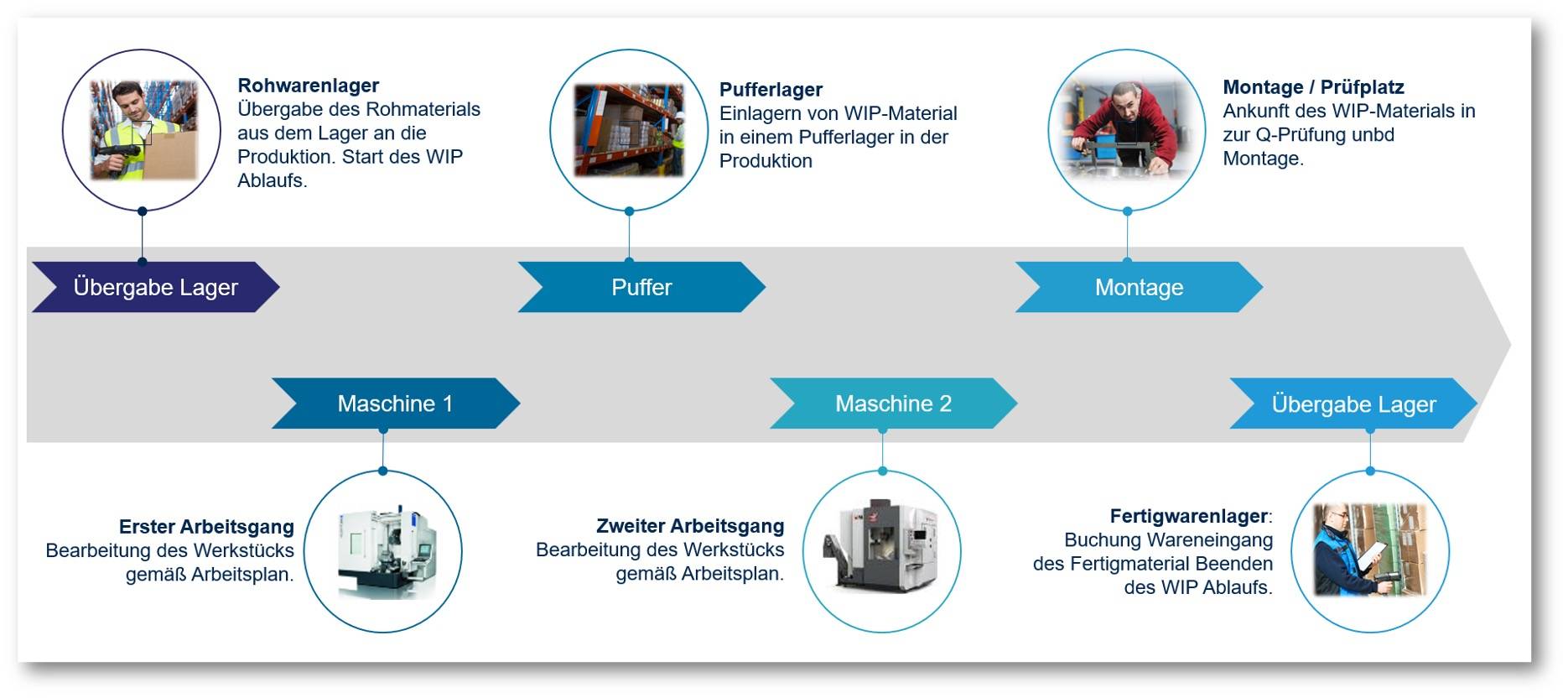
The WIP Process: How Material Flows Through Production
A typical WIP process begins with the provision of materials for production. In many companies, raw materials are already consumed by the production order at this point. From that moment on, the material no longer exists in the system as raw material. The Work in Process process begins.
Material Preparation and Handover
The picked materials are made available in designated handover areas between the warehouse and production. Logistics operations in these areas are generally still managed using ERP systems.
Transport, Processing and Temporary Storage
Transport to the workstations is often carried out just in time. After each processing step, the WIP is placed in temporary storage areas or buffers before being requested by the next workstation. This process is repeated multiple times depending on the routing.
Completion and Transition to Finished Goods
After the final work step, often a quality inspection, the completion confirmation is posted. Only at this point can the material once again be clearly identified as finished goods and transferred to the finished goods warehouse.
Figure 1: The path of WIP material through production
How Optimizing Work in Process Materials Affects Lead Times and Inventory Levels
A large amount of work-in-process material almost always leads to longer lead times, increasing work-in-process inventory, and higher capital commitment. The more material is in the process at the same time, the longer individual orders have to wait. Targeted control of the WIP process has a direct positive impact on planning reliability and delivery performance.
Why the Control of WIP Material is Crucial
Without active control, significant risks arise in the handling of Work in Process material:
- Capacity losses due to missing material at the workstation.
- Inefficient transportation and special trips.
- High search effort during shift changes and shift handovers.
- Quality issues due to long storage times or incorrect material allocation.
The control of Work in Process material is therefore a central component of modern production management.
Methods for Controlling Work in Process Material
Work in Process (WIP) material has limited visibility in ERP systems, which causes search times, delays, and unclear inventory levels. Digital tools such as MES systems or shop floor management dashboards fill this gap between production, logistics, and IT, enabling better planning. Real-time information on material flow, process statuses, and production progress is available at all times. This makes it possible to assign and track WIP material.
Digital Systems as the Key
Only digital systems, such as an MES System, make it possible to map, analyze, and actively control work-in-process material in real time. With these digital tools, every material item can be efficiently monitored using a digital ID. The degree of completion, material status, and process steps are displayed online and in real time, including on mobile devices via scanners or handheld terminals. This makes material flow planning more flexible, eliminates search times, and enables bottlenecks to be identified at an early stage.
Practical Example: Visibility of Work in Process (WIP) Material with Solutions from IGH Infotec AG.
A practical approach to controlling WIP material is the digital mapping of all internal material movements through a central control center. For this purpose, IGH Infotec AG uses the X-ControlCenter (X-CC), which serves as a control and transparency platform for WIP material.
Each work-in-process material item is managed in a virtual container with a unique container ID. This makes it possible to clearly assign, track, and transport material quantities between individual production steps. Transport orders for Work in Process material are created, prioritized, and distributed centrally through the system to the mobile devices of logistics employees. They can process and confirm the orders directly.
This structure creates a fully documented WIP process across all workstations, machines, buffer areas, quality zones, and temporary storage locations. The key benefit is complete transparency regarding the location, status and quantity of every WIP container. Search times are eliminated, bottlenecks become visible earlier, and the material supply to production becomes significantly more reliable.
In addition, the system supports optimized transport control through features such as multi-order trips, priority-based logic, and automatic destination suggestions. This allows internal transports to be consolidated more efficiently and sustainably increases the performance of intralogistics operations.
More transparency about WIP material within your own operation? Learn more about the X-ControlCenter now and benefit from complete WIP visibility.
Conclusion: Actively Control Work in Process Material Instead of Merely Managing It.
WIP material is one of the greatest and often most underestimated levers for improving efficiency in production. Companies that make their WIP process transparent and actively control it reduce lead times, lower inventory levels, and sustainably improve on-time delivery performance. Digital solutions provide the foundation for transforming Work in Process material from an operational risk factor into a strategic competitive advantage.
